Maximizing Your HSA: 2026 Cap & 20% Tax Advantage
Advertisements
Looking to slash your federal tax bill while building a dedicated medical nest egg before year-end? Maximizing your HSA under the 2026 IRS contribution limit gives eligible workers an immediate 20% or greater tax advantage on every dollar set aside for healthcare.
Unlike flexible spending accounts that expire annually, a triple-tax-advantaged Health Savings Account lets payroll contributions go in tax-free, grow untouched by capital gains taxes, and fund qualified medical expenses without federal levies.
Noticeably, the official 2026 IRS ceiling is $4,400 for self-only coverage (up from $4,300 in 2025) and $8,750 for families, plus an extra $1,000 catch-up contribution if you are 55 or older.
Whether you are finalizing fall Open Enrollment elections or topping off your balance ahead of the April tax deadline, capturing the full annual limit strengthens long-term retirement resilience. Here is how to verify your plan eligibility and squeeze maximum value out of your healthcare account.
Understanding the 2026 HSA Contribution Cap Increase
The Internal Revenue Service recently announced the new Health Savings Account (HSA) contribution limits for 2026, setting the individual cap at $4,300. This marks a significant increase, providing workers with an enhanced opportunity to save for healthcare expenses on a tax-advantaged basis.
This adjustment reflects ongoing efforts to keep pace with rising healthcare costs and inflation, ensuring HSAs remain a powerful tool for financial planning. The new limit directly impacts how individuals can approach their health and retirement savings strategies.
For families, the 2026 HSA contribution cap is also seeing an upward revision, further solidifying the HSA's role in comprehensive financial wellness. These changes are crucial for anyone looking to optimize their healthcare spending and investment.
The Instant 20% Tax Advantage Explained
The instant 20% tax advantage associated with the 2026 HSA contribution cap of $4,300 stems from the unique tax treatment of these accounts. Contributions are tax-deductible, reducing an individual's taxable income in the year they are made.
This immediate deduction, combined with potential state tax benefits, often translates to a substantial upfront savings for taxpayers. For many, this effectively means every dollar contributed to an HSA costs less than a dollar out of pocket, thanks to the tax relief.
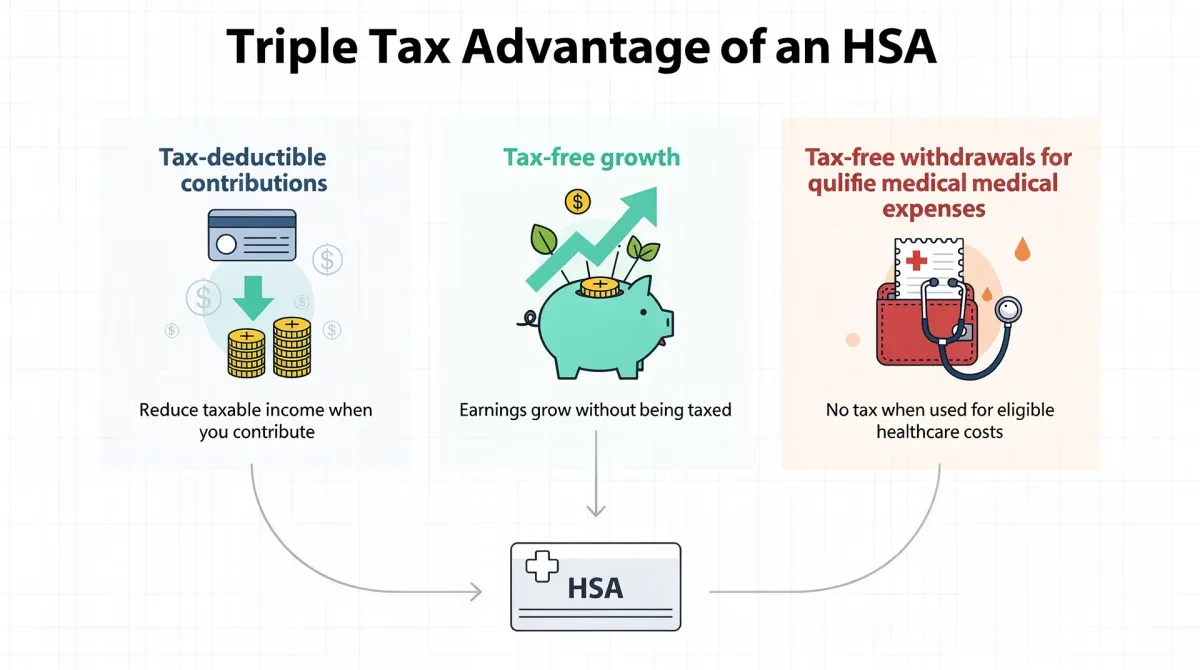
Beyond the initial deduction, HSA funds grow tax-free and withdrawals for qualified medical expenses are also tax-free, creating a powerful triple tax advantage. This makes maximizing Your HSA a critical financial move.
How Tax Deductions Work
Contributions are made with pre-tax dollars, lowering your adjusted gross income.
This reduction in taxable income can lead to a lower overall tax bill.
The exact percentage of tax advantage depends on your individual tax bracket.
The tax benefits are not merely theoretical; they translate into tangible savings for workers across various income levels. Understanding these mechanics is key to fully appreciating the value of the new HSA 2026 contribution cap.
Eligibility Requirements for HSA Participation
To be eligible for an HSA, an individual must be covered under a High Deductible Health Plan (HDHP) and not be enrolled in Medicare. They also cannot be claimed as a dependent on someone else's tax return.
The IRS sets specific criteria for what constitutes an HDHP, including minimum deductible amounts and maximum out-of-pocket limits. These thresholds are also adjusted periodically, and it is important to verify current figures.
Meeting these eligibility requirements is the foundational step to begin maximizing Your HSA. Without an eligible HDHP, individuals cannot contribute to an HSA.
HDHP Criteria for 2026
To qualify to open and fund an HSA in 2026, your health insurance must meet strict IRS High-Deductible Health Plan (HDHP) thresholds:
Minimum deductible for self-only coverage: $1,700 (up from $1,650 in 2025)
Maximum out-of-pocket for self-only coverage: $8,500 (up from $8,300 in 2025)
Minimum deductible for family coverage: $3,400 (up from $3,300 in 2025)
Maximum out-of-pocket for family coverage: $17,000 (up from $16,600 in 2025)
Not every plan marketed as "high-deductible" satisfies federal HSA rules—having non-preventive copays before meeting the deductible or pairing your plan with a general-purpose FSA can disqualify your eligibility.
Always confirm your plan's official HSA-eligible designation with your benefits administrator or insurer, especially if you are comparing 2027 coverage options (when minimum deductibles rise to $1,750 for individuals and $3,500 for families).
Strategic Investment Opportunities within an HSA
One of the most compelling aspects of HSAs, especially with the increased HSA 2026 contribution cap, is the ability to invest the funds. Unlike a typical savings account, many HSA providers offer investment options once a certain cash balance is maintained.
This allows the money to grow over time, compounding tax-free, much like a 401(k) or IRA. For those who can afford to pay for current medical expenses out-of-pocket, an HSA can effectively function as an additional retirement savings vehicle.
The long-term growth potential of invested HSA funds can be substantial, particularly for younger workers who have decades until retirement. This makes maximizing Your HSA a powerful strategy.
Popular HSA Investment Options
Mutual funds: Diversified portfolios managed by professionals.
Exchange-Traded Funds (ETFs): Often offer lower expense ratios and diversification.
Individual stocks: For those seeking direct control and higher risk/reward.
Choosing the right investment strategy depends on individual risk tolerance, financial goals, and time horizon. It is advisable to research different HSA providers and their investment platforms to find the best fit.
Comparing HSA with Other Retirement Accounts
While HSAs are primarily for healthcare, their investment capabilities and triple tax advantage often lead to comparisons with traditional retirement accounts like 401(k)s and IRAs. Each account has distinct benefits and limitations.
Unlike 401(k)s and IRAs, HSA withdrawals are tax-free if used for qualified medical expenses, regardless of age. This flexibility for healthcare costs in retirement is a significant advantage that other accounts do not offer.
For those looking to optimize their savings, understanding how the HSA 2026 contribution cap fits into a broader financial plan is crucial. It can complement, rather than replace, other retirement savings vehicles.
Key Differences in Account Benefits
HSA: Triple tax advantage (deductible contributions, tax-free growth, tax-free withdrawals for medical).
401(k): Tax-deferred growth, employer match often available.
IRA: Tax-deferred (Traditional) or tax-free withdrawals in retirement (Roth).
Financial advisors often recommend fully funding an HSA after contributing enough to a 401(k) to receive any employer match. This balanced approach ensures individuals maximize all available tax-advantaged savings opportunities.
The Impact of Inflation on HSA Contribution Limits
The annual adjustments to HSA contribution limits, including the 2026 HSA contribution cap, are primarily driven by inflation. The IRS uses specific metrics to calculate these increases, aiming to ensure the accounts retain their value over time.
This mechanism helps maintain the purchasing power of HSA funds for future medical expenses, which are also subject to inflationary pressures. Without these adjustments, the real value of the contribution limit would erode.
For workers planning long-term, these regular increases are a welcome feature, reinforcing the stability and utility of HSAs. It ensures that Maximizing Your HSA remains a pertinent strategy.
Factors Influencing HSA Limit Adjustments
Consumer Price Index (CPI): A key indicator of inflation used by the IRS.
Healthcare cost trends: The rising cost of medical services and prescriptions.
Legislative reviews: Occasional congressional action can also influence limits.
While the increases are generally positive, it is important for individuals to stay informed about the specific numbers each year. This allows for accurate financial planning and contribution strategies.

Practical Steps for Maximizing Your HSA Benefits
To fully capitalize on the 2026 HSA contribution cap, individuals should first ensure they are enrolled in an eligible HDHP. Verifying eligibility is the critical first step before any contributions can be made.
Next, aim to contribute the maximum allowable amount each year, if financially feasible. This ensures you take full advantage of the tax deductions and the opportunity for tax-free growth.
Consider investing your HSA funds once you have a comfortable cash reserve for immediate medical needs. This allows your money to grow significantly over time, becoming a substantial asset for future healthcare costs or retirement.
Best Practices for HSA Management
Automate contributions to consistently reach the HSA 2026 contribution cap.
Keep detailed records of all medical expenses, even if paid out-of-pocket, for future tax-free reimbursements.
Review investment options regularly and adjust based on market conditions and personal goals.
By following these practical steps, individuals can effectively leverage the new HSA limits to build a robust financial safety net for healthcare, both now and in retirement. Maximizing Your HSA is within reach.
Key Point | Brief Description |
|---|---|
2026 Cap Increase | Individual HSA contribution limit rises to $4,300, offering more saving potential. |
Instant Tax Advantage | Contributions are tax-deductible, providing an immediate reduction in taxable income. |
Triple Tax Benefit | Tax-deductible contributions, tax-free growth, and tax-free withdrawals for qualified expenses. |
Investment Potential | HSA funds can be invested and grow tax-free, serving as a retirement asset. |
Frequently Asked Questions About HSA 2026 Contribution Cap
What is the new individual HSA contribution cap for 2026?▼
The individual HSA contribution cap for 2026 has been set at $4,300 by the IRS. This new limit provides a greater opportunity for eligible individuals to save and invest for future healthcare expenses on a tax-advantaged basis, impacting financial planning significantly.
How does the 20% tax advantage work with the HSA cap?▼
The 20% tax advantage comes from the immediate tax deduction on contributions to your HSA. Depending on your tax bracket, contributing to the HSA 2026 contribution cap can significantly reduce your taxable income, leading to instant savings on your annual tax bill.
Who is eligible to contribute to an HSA in 2026?▼
To contribute to an HSA in 2026, you must be covered under a High Deductible Health Plan (HDHP), not be enrolled in Medicare, and not be claimed as a dependent. Your HDHP must meet specific IRS deductible and out-of-pocket limits for the year.
Can HSA funds be invested, and how do they grow tax-free?▼
Yes, HSA funds can be invested through various options offered by providers, such as mutual funds or ETFs. These investments grow tax-free, meaning you don't pay taxes on capital gains or dividends. This tax-free growth is a key component of Maximizing Your HSA benefits.
What are the long-term benefits of Maximizing Your HSA?▼
Long-term benefits include significant tax savings, a dedicated fund for future medical expenses, and potential for substantial investment growth. An HSA can also serve as an additional retirement savings vehicle, providing tax-free withdrawals for qualified medical costs in retirement.
Perspectives
The increased 2026 HSA contribution cap of $4,300 underscores the growing importance of Health Savings Accounts in personal finance. As healthcare costs continue to rise, leveraging these tax-advantaged accounts becomes even more critical for American workers.
This development highlights a broader trend towards empowering individuals with more control over their healthcare spending and investment strategies. Individuals should review their current health plans and financial goals to fully capitalize on maximizing Your HSA.