2026 Vocational Training: Industries’ Demands from Graduates Now
Advertisements
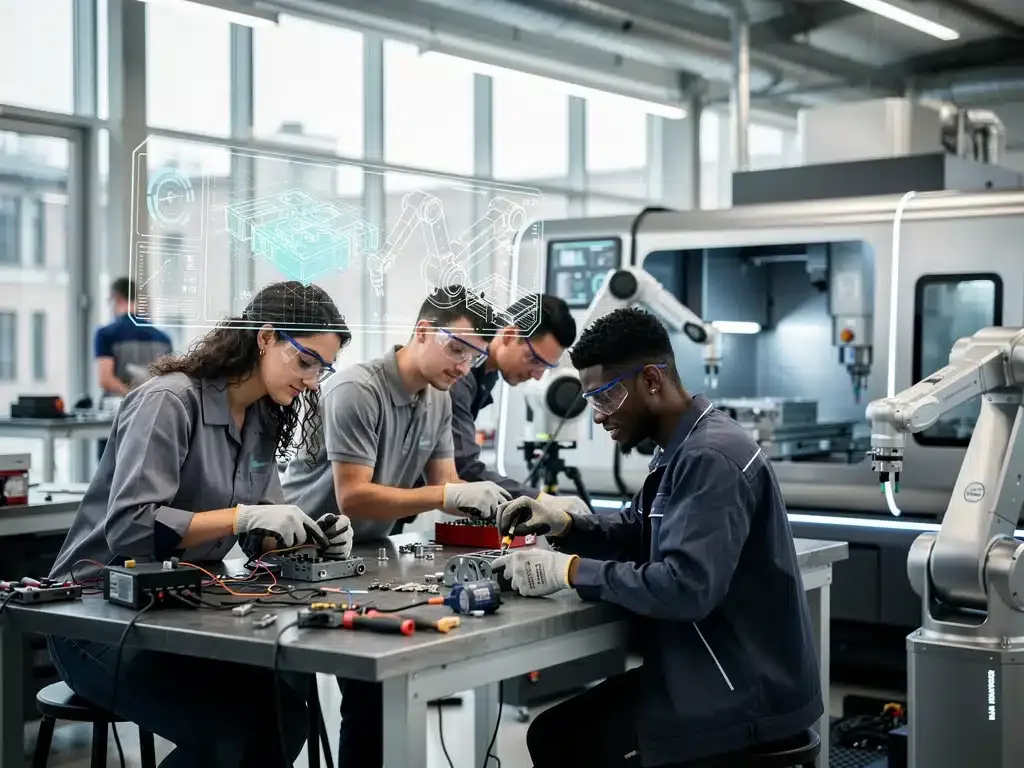
Driven by rapid technological advancements and shifting economic priorities, the 2026 vocational training landscape requires more than just foundational skills.
This report breaks down the specific technical competencies, adaptability, and practical problem-solving capabilities now demanded across five critical US industries to help educators and students align with workforce needs.
The Evolving Demands of the Information Technology Sector
The Information Technology (IT) sector continues its rapid expansion, creating a constant need for skilled professionals.
However, the nature of these skills is evolving, with a strong emphasis on cybersecurity, cloud computing, and data analytics.
Graduates entering IT in 2026 must demonstrate not only proficiency in programming languages and network administration but also a deep understanding of data privacy regulations and ethical AI development.
The demand for IT specialists capable of safeguarding digital infrastructure and managing complex cloud environments is at an all-time high.
This shift reflects the increasing digital transformation across all industries, making robust IT infrastructure and secure data management non-negotiable.
Vocational programs must integrate advanced modules in these areas to prepare students effectively for the 2026 Vocational Training Landscape.
Cybersecurity Specializations in High Demand
- Network Security Analysts: Protecting systems from unauthorized access.
- Ethical Hackers: Identifying vulnerabilities before malicious actors.
- Cloud Security Engineers: Securing data and applications hosted on cloud platforms.
The proliferation of cyber threats means that basic IT security knowledge is no longer sufficient; specialized roles requiring advanced certifications are now standard.
Companies are actively seeking individuals who can implement proactive security measures and respond effectively to breaches, demonstrating a critical need within the 2026 Vocational Training Landscape.
Furthermore, the legal and ethical implications of data breaches are pushing vocational programs to include comprehensive training on compliance frameworks like GDPR and CCPA.
This ensures graduates are not only technically proficient but also legally and ethically responsible.
Healthcare’s Shift Towards Digital and Specialized Care
The healthcare industry is experiencing a profound transformation, driven by advancements in medical technology and an aging population.
Vocational graduates in healthcare are now expected to be proficient with digital health records, telehealth systems, and specialized diagnostic equipment.
Beyond traditional patient care, there’s a growing need for technicians capable of operating and maintaining sophisticated medical devices, as well as administrative staff skilled in managing complex digital patient information.
The emphasis is on efficiency, accuracy, and patient-centered care, all supported by technology.
The 2026 Vocational Training Landscape for healthcare professionals requires a blend of clinical expertise and technological literacy.
This ensures graduates can seamlessly integrate into modern healthcare settings, which are increasingly reliant on digital solutions.
Emerging Roles in Healthcare Technology
- Health Information Technicians: Managing electronic health records and data.
- Medical Equipment Repairers: Maintaining and calibrating advanced diagnostic tools.
- Telehealth Support Specialists: Facilitating remote patient consultations and monitoring.
Vocational programs are adapting by incorporating simulations of telehealth appointments and hands-on training with electronic health record software.
This practical exposure is vital for graduates to meet the immediate demands of healthcare providers.
Additionally, the focus on preventative care and chronic disease management means that graduates need strong communication skills to educate patients and support long-term health outcomes.
This holistic approach is a hallmark of the evolving 2026 Vocational Training Landscape.
Renewable Energy Sector’s Growing Need for Technicians
The renewable energy sector is expanding rapidly, fueled by environmental concerns and government initiatives.
This growth creates a significant demand for skilled technicians in solar, wind, and geothermal energy installation and maintenance.
Graduates entering this field must possess a strong understanding of electrical systems, safety protocols, and the specific technologies associated with various renewable energy sources.
The ability to troubleshoot complex systems and work effectively in diverse environments, from rooftops to remote wind farms, is crucial.
The 2026 Vocational Training Landscape for renewable energy requires individuals who are not only technically adept but also committed to sustainable practices and continuous learning as technologies evolve.
This sector offers robust career opportunities for those with specialized skills.
Specialized Skills for Green Jobs
- Solar Panel Installers and Technicians: Expertise in photovoltaic systems.
- Wind Turbine Technicians: Maintenance and repair of wind energy infrastructure.
- Energy Efficiency Auditors: Assessing and improving energy consumption in buildings.
Vocational training programs are investing in state-of-the-art labs that simulate real-world renewable energy installations.
This hands-on experience ensures graduates are familiar with the tools and techniques required for immediate employment in the 2026 Vocational Training Landscape.
Furthermore, safety training is paramount, given the inherent risks associated with working on electrical systems and at heights. Programs are emphasizing rigorous safety certifications to prepare graduates for demanding field conditions.
Advanced Manufacturing’s Embrace of Automation and Robotics
Advanced manufacturing is undergoing a revolution, integrating automation, robotics, and artificial intelligence into production processes.
This transformation demands vocational graduates who can program, operate, and maintain sophisticated machinery.
The modern manufacturing floor requires technicians who understand industrial control systems, mechatronics, and data-driven process optimization.
The ability to work collaboratively with engineers and adapt to new technologies quickly is a key differentiator for success in this sector.
The 2026 Vocational Training Landscape for manufacturing professionals is less about manual labor and more about intellectual engagement with complex automated systems.
Graduates must be prepared for roles that blend mechanical aptitude with digital proficiency.
Key Competencies in Modern Manufacturing
- Robotics Technicians: Programming and maintaining industrial robots.
- Automation Specialists: Designing and implementing automated production lines.
- Mechatronics Technicians: Combining mechanical, electrical, and computer engineering skills.
Vocational schools are establishing partnerships with manufacturing companies to provide students with access to cutting-edge equipment and real-world projects.
This practical exposure ensures graduates are familiar with industry standards and emerging technologies, a vital aspect of the 2026 Vocational Training Landscape.
Soft skills, such as problem-solving, critical thinking, and teamwork, are also increasingly important. Manufacturers seek employees who can contribute to continuous improvement initiatives and adapt to rapidly changing production demands.
The Critical Role of Cybersecurity in All Industries
While mentioned within IT, cybersecurity’s pervasive nature warrants its own focus as a standalone demand across virtually all industries.
Every sector, from finance to retail to government, is now a target for cyber threats, creating an urgent need for cybersecurity professionals.
Graduates with vocational training in cybersecurity are in high demand to protect sensitive data, secure networks, and respond to incidents.
This includes roles in security operations, threat analysis, and compliance management, ensuring organizational resilience against digital attacks.
The 2026 Vocational Training Landscape places cybersecurity at its core, recognizing that a secure digital environment is foundational for business operations and national security.
Specialized training in this area offers robust career prospects.
Cross-Industry Cybersecurity Needs
- Security Operations Center (SOC) Analysts: Monitoring and responding to security incidents.
- Penetration Testers: Simulating attacks to find system vulnerabilities.
- Data Privacy Officers: Ensuring compliance with data protection regulations.
Vocational programs are developing immersive cybersecurity labs where students can practice defensive and offensive security techniques in a controlled environment.
This hands-on experience is crucial for building the practical skills required by employers in the 2026 Vocational Training Landscape.
Furthermore, ethical considerations and legal frameworks are integral to cybersecurity training, preparing graduates to navigate the complex landscape of digital ethics and regulatory compliance.
The demand for these professionals will only continue to grow.
Construction and Skilled Trades: Adapting to New Technologies
The construction industry and skilled trades are experiencing a revitalization, driven by infrastructure projects and sustainable building practices.
However, the traditional trades are now integrating advanced technologies like Building Information Modeling (BIM), drones, and modular construction techniques.
Vocational graduates in trades such as carpentry, electrical work, and plumbing are increasingly expected to be proficient with digital tools for project planning, site management, and precise execution.
The ability to interpret digital blueprints and work with smart building systems is becoming standard.
The 2026 Vocational Training Landscape for construction demands tradespeople who are not only masters of their craft but also digitally literate and adaptable to innovative construction methods. Efficiency and precision are key drivers in this evolving sector.
Technological Integration in Skilled Trades
- BIM Technicians: Utilizing 3D models for construction planning and execution.
- Drone Operators for Site Surveying: Capturing aerial data for progress monitoring.
- Smart Home Technicians: Installing and maintaining integrated building systems.
Vocational schools are updating their workshops with modern equipment and software to reflect these technological shifts.
Students are learning to use digital tools for measurement, design, and project management, preparing them for the advanced demands of the 2026 Vocational Training Landscape.
Safety remains paramount, but training now extends to understanding the safety implications of new technologies and automated equipment.
The emphasis is on creating a safer, more efficient, and technologically advanced construction workforce.
Logistics and Supply Chain Management: Automation and Data-Driven Efficiency
The logistics and supply chain management sector, critical for global commerce, is being reshaped by automation, data analytics, and artificial intelligence.
The demand is for vocational graduates who can manage complex global networks, optimize inventory, and operate automated warehousing systems.
Professionals in this field must be adept at using Enterprise Resource Planning (ERP) software, understanding predictive analytics for demand forecasting, and implementing efficient last-mile delivery solutions.
The ability to navigate international trade regulations and manage cross-cultural teams is also increasingly important.
The 2026 Vocational Training Landscape in logistics requires individuals who can leverage technology to enhance efficiency, reduce costs, and ensure the timely movement of goods. This sector is vital for economic stability and growth.
Skills for Modern Supply Chain Roles
- Logistics Coordinators: Managing transportation and warehousing operations.
- Supply Chain Analysts: Using data to optimize processes and identify efficiencies.
- Automated Warehouse Technicians: Operating and maintaining robotic sorting and storage systems.
Vocational programs are integrating simulations of global supply chains and providing training in advanced inventory management software.
This practical exposure ensures graduates are ready to contribute to complex logistics operations immediately, aligning with the 2026 Vocational Training Landscape.
Furthermore, problem-solving skills and adaptability are crucial, as supply chains are frequently disrupted by global events.
Graduates must be able to quickly analyze situations and implement effective solutions to maintain operational continuity.
Preparing for the Future: Adaptability and Soft Skills
Beyond specific technical competencies, the overarching demand across all industries in the 2026 Vocational Training Landscape is for adaptability, critical thinking, and robust soft skills.
The rapid pace of technological change means that lifelong learning is no longer an option but a necessity.
Employers are seeking graduates who can not only perform specific tasks but also learn new technologies quickly, solve unstructured problems, and collaborate effectively in diverse teams.
Communication, problem-solving, and resilience are now considered as important as technical proficiency.
Vocational programs are increasingly incorporating modules focused on these transversal skills, often through project-based learning and real-world case studies.
This holistic approach prepares graduates not just for their first job but for a dynamic and evolving career trajectory.
Essential Soft Skills for 2026 Graduates
- Critical Thinking: Analyzing complex situations and making informed decisions.
- Problem-Solving: Developing effective solutions to challenges.
- Communication: Articulating ideas clearly and collaborating with others.
- Adaptability: Adjusting to new technologies and changing work environments.
The integration of these soft skills into vocational curricula ensures that graduates are well-rounded professionals capable of thriving in various industrial settings.
This emphasis on human-centric skills complements technical expertise, making graduates more valuable to employers in the 2026 Vocational Training Landscape.
Mentorship programs and internships are also playing a crucial role in developing these skills, providing students with opportunities to apply their knowledge in professional contexts and receive constructive feedback.
This practical experience bridges the gap between academic learning and industry expectations.
| Key Industry | Primary Demands for Graduates |
|---|---|
| Information Technology | Cybersecurity, Cloud Computing, Data Analytics. |
| Healthcare | Digital Health Records, Telehealth, Medical Device Operation. |
| Renewable Energy | Solar/Wind Installation, Electrical Systems, Safety Protocols. |
| Advanced Manufacturing | Robotics, Automation, Industrial Control Systems. |
Frequently Asked Questions About 2026 Vocational Training Demands
What are the most critical skills for vocational graduates by 2026?▼By 2026, critical skills include advanced technical proficiencies in areas like cybersecurity, cloud computing, and automation, coupled with strong soft skills such as adaptability, critical thinking, and problem-solving. Digital literacy across all fields is paramount.
How are vocational programs adapting to these new industry demands?▼Vocational programs are integrating cutting-edge technologies, updating curricula to include specialized modules, and fostering partnerships with industries for hands-on experience. They are also emphasizing project-based learning and soft skill development to ensure graduates are workplace-ready.
Which industries show the highest demand for vocational graduates in 2026?▼Industries with the highest demand include Information Technology (especially cybersecurity), Healthcare (digital and specialized care), Renewable Energy, Advanced Manufacturing, and Logistics. These sectors are rapidly evolving and require a skilled, adaptable workforce.
What role does technology play in the 2026 Vocational Training Landscape?▼Technology is a central driver, influencing curriculum content and delivery methods. Graduates must be proficient in digital tools, automation, and data analytics relevant to their fields. Vocational training now heavily incorporates simulations and advanced equipment to prepare students.
Why are soft skills increasingly important for vocational graduates?▼Soft skills like adaptability, critical thinking, and communication are crucial because technical skills alone are insufficient in a rapidly changing job market. Employers seek individuals who can learn new technologies, solve complex problems, and collaborate effectively, ensuring long-term career success.
Looking Ahead: Shaping the Future Workforce
The insights into the 2026 Vocational Training Landscape provide a clear directive for educators, students, and policymakers.
The future workforce demands a blend of specialized technical skills and robust soft skills, emphasizing adaptability and continuous learning.
Monitoring ongoing technological advancements and industry shifts will be crucial for maintaining curriculum relevance.
The success of vocational training hinges on its ability to evolve proactively, ensuring graduates are not just qualified but truly future-ready.
This dynamic environment underscores the importance of collaboration between educational institutions and industries to bridge the skills gap effectively.
Investing in modern training infrastructure, fostering a culture of innovation, and understanding the core impact of modern career education programs will define the preparedness of the American workforce for the challenges and opportunities ahead.